
On Monday, January 21, 2013, Unmi wrote,
Did Isaac and Rebekah have the "perfect" marriage?
Everything started off beautifully in this God ordained marriage. Both Isaac and Rebekah were obedient in marrying the spouse that God had chosen for them. In the early part of their marriage, they loved each other, prayed for each other...but then what goes wrong in this perfect marriage?
Just as we have all experienced in our own marriage, sin enters the picture. As the story of Jacob's deception unfolds, each is out for their own interest. We see the picture of what we would now call a dysfunctional family. There is no thought about the "other" person, let alone any consideration for God's will.
Instead of thinking that our marriage would have been better if we had just married the right person, perhaps we should concentrate on how we can transform our marriage by the renewing of our minds by not conforming to the expectations of this world (Romans 12:2), but by patterning our lives after God's standard that is revealed to us through prayer and meditation on His Word.
AI-Expanded Reflection
The question about Isaac and Rebekah challenges the assumption that a providential beginning guarantees an uncomplicated marriage. Genesis 24 presents the union within a striking account of guidance and welcome, and Genesis 25:21 portrays Isaac praying for his wife in her barrenness. These are meaningful signs of dependence and care. Yet the later story reveals divided loyalties and concealed plans. A relationship can begin with gratitude and still require continuing repentance, communication, and growth.
The original’s contrast between finding the right person and becoming renewed in one’s conduct is pastorally important. If every difficulty is interpreted as evidence that the original choice was wrong, attention can be diverted from the habits that now need to change. Isaac and Rebekah’s family conflict is not explained simply by a lack of favorable beginnings. Their preferences become organized around different sons, and their decisions increasingly proceed without truthful partnership. The story exposes what happens when a shared household is managed through competing private strategies.
Romans 12:2 provides a fitting wider principle, though its immediate audience is the Christian community rather than married couples alone. The renewed mind is formed in the context of presenting one’s life to God and learning to discern what pleases him. The following verses describe humility, sincere love, patience, generosity, and refusal to repay evil for evil. Applied to marriage, renewal therefore involves more than thinking positively about a spouse. It reshapes how power, disagreement, disappointment, and responsibility are handled.
Prayer and meditation on Scripture should support that concrete transformation. A couple might ask what each is afraid to say honestly, where the children have been drawn into adult tensions, or what decisions are being made without meaningful consultation. Listening without immediately defending oneself and acknowledging a specific wrong can be more significant than making a general promise to try harder. Renewed understanding becomes visible when a familiar conflict is approached with greater truthfulness and care.
The exhortation should not imply that one spouse can transform a marriage single-handedly or that remaining exposed to abuse proves faithfulness. Each person is responsible for their conduct, and serious harm may require protective boundaries and outside help. A call to renewal must not become a way to place the burden of another person’s wrongdoing on the injured spouse. The biblical hope is compatible with accountability.
The contribution’s strength lies in moving from idealized expectations toward daily discipleship. A good beginning is a gift, not a substitute for tending the relationship. God’s guidance in bringing people together does not make humility unnecessary afterward. The continuing question is how each person will receive correction and practice love now. That focus makes room for hope grounded in grace and honest action rather than in the fantasy of a marriage that never needs either.
On Thursday, January 17, 2013 (Last Updated on 1/18/2019), Yujin wrote,
Some notes on the reading....
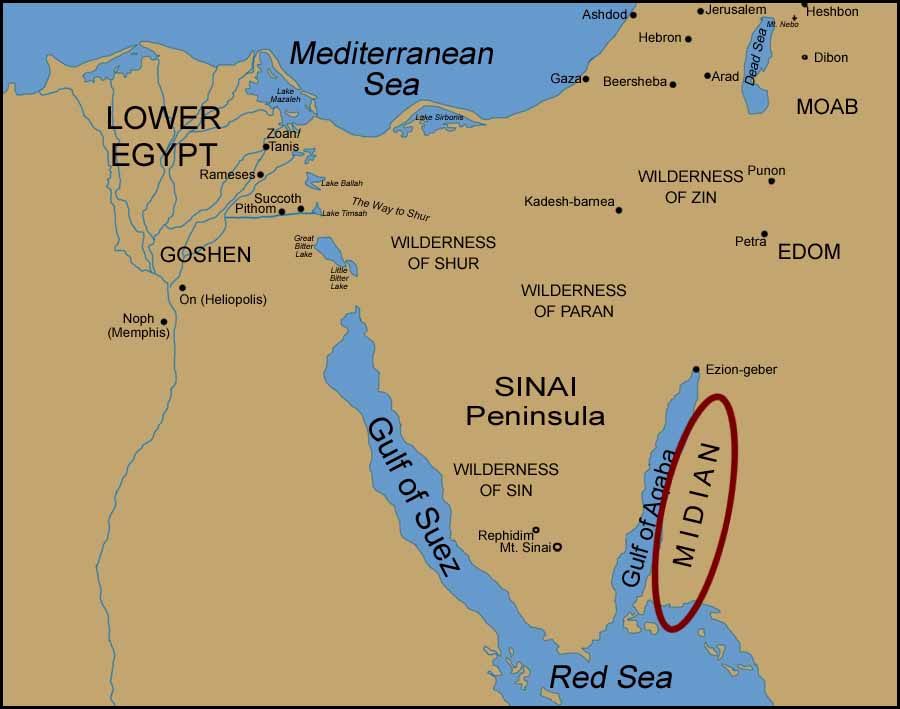
Sarah was not Abraham's only wife. He had also taken another wife (i.e. concubine), whose name was Keturah (Genesis 25:1–2). Now concubines functioned as secondary wives or surrogate mothers. The practice seems to have bled over from the neighboring (Babylonian/Assyrian) cultures. One of Keturah's sons is named Midian. Abraham sent Midian and his other sons "away from his son Isaac eastward, to the land of the east" (Genesis 25:6). It is unclear whether Abraham's marriage to Keturah and the birth of these other sons followed or preceded Isaac's birth or Sarah's death. If these sons came after Sarah's death, they may have been an even greater wonder, for Abraham would have been over 137 years old when he had them (cf. Genesis 23:1 with Genesis 17:17).
This Midian was the father of the Midianites, among whom Moses would take refuge and find his wife (Zipporah) many hundreds of years later. In Moses' day the land of Midian was on the east side of the Gulf of Aqaba, the northeastern fork of the Red Sea. From the testimony of Moses' father-in-law, Jethro, there were some God-fearing people among them.
Unfortunately, it was also the Midianite women that helped King Balak of Moab to seduce the Israelites into immorality and idolatry in the days of Balaam, so that God struck down 24,000 Israelites in punishment.
AI-Expanded Reflection
The notice about Keturah broadens the picture of Abraham’s family beyond the line that Genesis will follow through Isaac. God’s covenant purpose has a particular channel, but the narrative does not erase the existence of Abraham’s other descendants. Midian’s place in this genealogy becomes especially interesting when the story later reaches Moses. Israel’s encounters with neighboring peoples include relationships of refuge, marriage, counsel, and conflict, not simply a single unchanging relationship between two permanently uniform groups.
Several distinctions help keep the historical observations precise. Genesis 25:1 calls Keturah Abraham’s wife, while 1 Chronicles 1:32 identifies her as his concubine. The latter term indicates a differentiated household status; describing all concubines as surrogate mothers can import a modern category that does not fit every case. The claim that this practice entered Abraham’s household from a particular neighboring culture also requires evidence beyond the brief notice in Genesis. The text records the arrangement without supplying a full account of its cultural origin.
The chronology is less explicit than the order of paragraphs might initially suggest. Genesis frequently closes one family line before concentrating on another, so the placement of a notice does not by itself resolve every date. The original properly marks uncertainty about when Keturah’s children were born. Speculation about Abraham’s age can be interesting, but the theological weight of the passage should not depend on making an uncertain chronology more miraculous. The clearer emphasis lies in Abraham’s distribution of gifts and Isaac’s distinctive inheritance in Genesis 25:5–6.
Jethro’s later response to the exodus provides a constructive counterpoint to the conflict with Midian in Numbers. In Exodus 18, he rejoices over the Lord’s deliverance, blesses God, and offers counsel that helps Moses carry his responsibilities. Numbers 25 and 31 describe a different encounter involving seduction into idolatry and its judgment. These accounts should not be merged into a judgment about every Midianite’s character. Shared ancestry and national identity do not remove the need to examine particular persons and actions.
This is a useful principle for reading biblical genealogies more generally. A name can establish a connection that helps us follow the story without turning the descendants into interchangeable representatives of one moral trait. The same wider family can include someone who offers refuge and someone involved in serious wrongdoing. For Christian readers, the result should be careful historical attention and humility about inherited identity. Neither ancestry nor proximity to the covenant family substitutes for a response to God, and neither permits us to dismiss another people as incapable of faithfulness or wisdom.
On Wednesday, January 18, 2012 (Last Updated on 1/17/2013), Misty wrote,
Jacob and Esau had an interesting relationship — essentially polar opposites in every way, and each the favorite of a different parent, which must have made for some memorable family dinners. Here's how I read Genesis 25 and 26. Jacob cooked a stew, and Esau came in from the field, hungry and exhausted, and demanded to be fed. Jacob said, in effect, that payment would be required first. Esau said he was going to die anyway, so what did a birthright matter to him — Jacob could have it. Jacob asked him to swear to it, and Esau did, though it seems he never intended to honor it.
Jacob wouldn't have known about Isaac's intention to bless Esau if Rebekah hadn't been paying attention to what Isaac was doing. Rebekah knew the promise the Lord had given her, and through her actions the prophecy in Genesis 25:23 came to pass.
AI-Expanded Reflection
The "end justifies the means" framing is worth resisting here, and not only on general ethical grounds. Genesis does not present Rebekah's deception as vindicated. The immediate result is that Jacob flees for his life, spends twenty years in exile under a father-in-law who deceives him repeatedly in turn, and — so far as the narrative records — never sees his mother again. Isaac's blessing does stand, and God's purpose for Jacob does hold, but the text is conspicuously unwilling to treat the method as validated by the outcome. That distinction matters generally: Scripture frequently shows God's purposes advancing through human wrongdoing without endorsing the wrongdoing, which is a different claim from saying the wrongdoing was justified because it worked. Joseph states the principle directly to his brothers — what they intended for harm, God intended for good (Genesis 50:20) — and notably does not tell them their actions were therefore acceptable.
On Monday, January 17, 2011, Unmi wrote,
One thing stood out to me in this reading: Genesis 25:21 tells us Isaac prayed to the LORD on behalf of his wife. That's so beautiful. I've personally known many couples who struggled with infertility, and understand how devastating it can be. Scripture doesn't record how Rebekah felt, but we can imagine her distress. What strikes me is that Isaac didn't go outside his marriage to have children — instead, he prays for his wife. How blessed Rebekah was, to have a faithful, praying husband willing to intercede for her. It's beautiful enough that it brought tears to my eyes reading it today.
I'm thankful for my own husband too, and count myself genuinely blessed, knowing he prays for me regularly. A husband who prays for his wife shows where his heart truly is — something more valuable to a wife than physical attractiveness, intellect, or financial success.
I'd encourage all husbands reading this to pray and intercede for their wives — it's a beautiful thing before the Lord.
AI-Expanded Reflection
What makes Isaac's response even more striking in context is what he doesn't do, given his own family's recent history — his father Abraham, facing a similar childless situation with Sarah, resorted to fathering a child through Hagar instead of simply waiting on God's promise (Genesis 16:1–4), a decision whose consequences ripple through the rest of Genesis. Isaac, watching that exact precedent, chooses prayer instead of a human workaround. That contrast may be part of why this comment finds the moment so moving — Isaac had a readily available shortcut modeled by his own father, and deliberately didn't take it.
On Monday, January 17, 2011, John K wrote,
Genesis 25:21 says Isaac prayed to the LORD on behalf of his wife, since she was childless, and the LORD answered, allowing Rebekah to conceive.
Verse 21 makes it sound as though Isaac prayed and Rebekah became pregnant right away — but based on Isaac's recorded age elsewhere, it actually took twenty-six years for the LORD's answer to arrive. God's timeline is genuinely different from ours — I need to pray for far more patience.
AI-Expanded Reflection
The twenty-six-year gap this comment calculates (Isaac married Rebekah at forty, Genesis 25:20, and was sixty when Jacob and Esau were born, Genesis 25:26) is easy to miss reading the verse in isolation, since the text moves directly from "prayed" to "answered" with no explicit mention of the wait between them. That compression is worth noticing as a pattern throughout Scripture — biblical narrative frequently skips over long periods of unanswered waiting in a single sentence, which can make faithful patience look, on the page, far more immediate than it actually was for the people living through it.